Lyuda Kalinichenko

The Book about My Family. Eat While You Still Can and Drink While You Still Can
2016–2022
artist’s book, solo exhibition, video performance, sculpture, multimedia installation, objects

General view of the exhibition Ural Branch of the Pushkin State Museum of Fine Arts, Yekaterinburg
Alisa Sycheva, curator and art historian, writes in the curatorial text for the exhibition Eat While You Still Can and Drink While You Still Can:

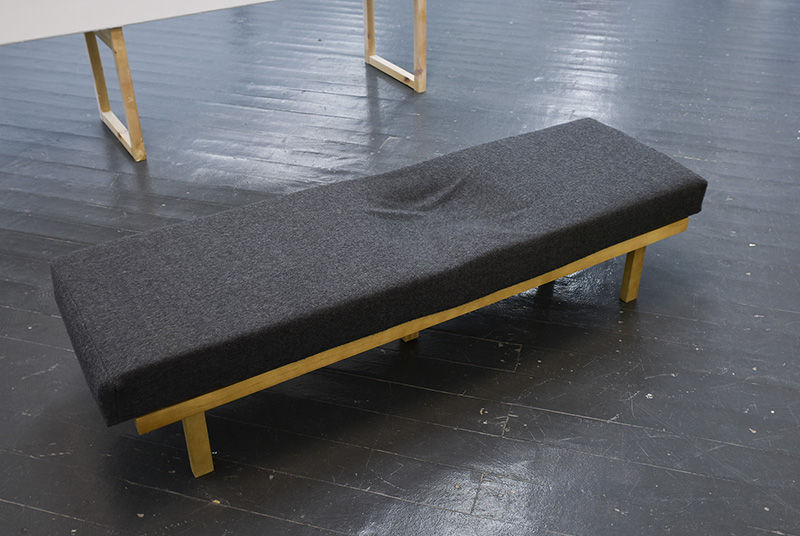
Bench with memory foam
“In my family, a shared meal has always been considered a moment when peace begins, like the Olympic Games in Ancient Greece: all quarrels and disagreements are left outside the frame, and by passing food to one another, we remember that we are the closest people to each other.
This is a ritual practised in many families: the family meal as a special form of togetherness, and also as a stage where the contradictory love within a family appears — a love that is often not spoken about aloud.
Family recipes preserve history. Like circles spreading across water, this history moves from one family to generations, to historical events, revealing the secrets of origin.
Lyudmila Kalinichenko’s solo exhibition tells stories that are both very simple and very complex — about memory, family, and the search for identity through one’s own past. Here, Lyuda creates a three-dimensional space of a book about her family. She visualises the work of human memory: how it brings some things to the foreground, enlarges them, multiplies them endlessly, while erasing others.
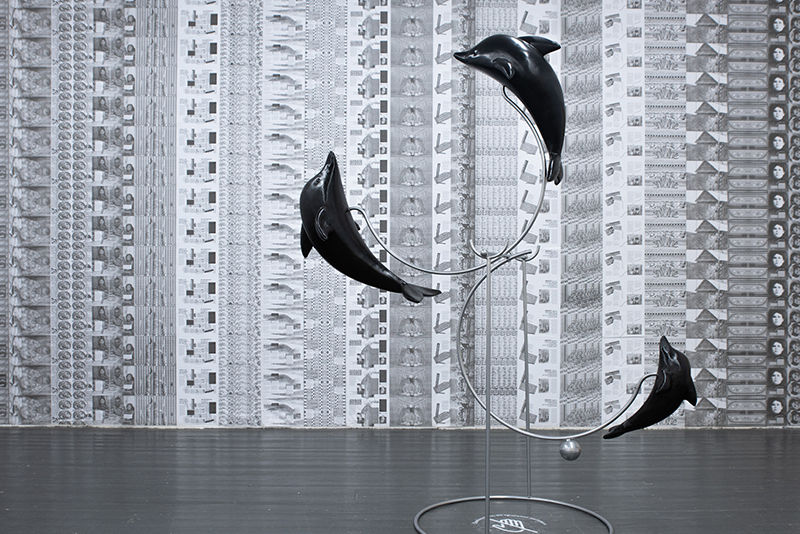
Souvenir dolphins grow larger, birds from a grandmother’s sideboard come to life, and pages of family recipes cover the walls in an endless pattern. The viewer watches the dreams of the artist’s memory while settling into the soft cushions of the exhibition — personal memories turned inside out.
The project is a Ural version of Proust’s In Search of Lost Time, where, instead of the legendary madeleine, the essence of memory is held in a grandfather’s ‘blue dumplings’, ‘sour cream with sugar’, and the misty blue eyes of the artist’s grandmother. By an interesting coincidence, just like the great French writer, the artist suddenly understands what she needs to do at a particular moment: to create a book about her family, to make a journey towards herself, and then to embody that book in space.
Like the ‘Proust phenomenon’, multiple fragmented images, objects and texts from childhood, together with sensory memories, lead the viewer through the surreal world of Lyudmila Kalinichenko’s visualised memory.”
Kristina Syrchikova, curator of After Photography, writes:
“The motif of food is an important aspect of Lyudmila Kalinichenko’s work. We encounter it both in the installation and in the book of the same name. Recipes, stories about hunger and food culture, mixed with family stories and photographs of relatives, bring the whole family together. By cooking from the recipes included in the book, one can connect to ancestral memory, as these recipes were passed down by word of mouth and preserved like treasures.”
Artist’s book: A Book About My Family, 2022 / 188 pages / Edition of 30 copies
“Eat while you still can, and drink while you still can!” — this is a phrase I often heard from my grandmother. For me, it means: value the moment, enjoy life, and when there is a chance to do something — do it".
Dolphins, kinetic sculpture, prototype of a souvenir pendulum
“Eat while you still can, and drink while you still can!” — this is a phrase I often heard from my grandmother. For me, it means: value the moment, enjoy life, and when there is a chance to do something — do it.
Several years ago, my grandmother accidentally threw away the entire family photo archive instead of the rubbish. It could be said that our family was left without a past, and the only remaining thread was my grandmother’s memory. From her stories, we reconstructed the chronology of events, the family tree, and important dates in my family history. Some photographs were found through relatives, thanks to the old tradition of ordering several copies from a photo studio and giving them to family members.
It is worth noting that peer-to-peer networks work in a similar way: each participant stores an identical set of information. If one node fails, the system continues to function. Another part of the photo archive was re-photographed during journeys to places of memory.
Later, the idea came to collect all this material into a book.
The process took several years, gradually accumulating new events, documents and information. On the eve of my birthday, the world turned upside down, priorities changed, and I regretted not having done several things in my life — one of them was A Book About My Family.
I spent hours talking to my grandmother on the phone, travelled to visit relatives, and transcribed interviews at night. Two weeks later, the book went to print.
The book includes recipes regularly cooked by my relatives: “blue dumplings”, “bread with sugar”, and sukharnitsa. The taste and the process of making these dishes allow one to physically sense the experience and atmosphere of that time. The book spreads include images of three-dimensional collages made from archival photographs, family objects and found materials.
The collages are made using analogue methods, but they imitate the appearance of digital effects.
— Lyudmila Kalinichenko

Four-hour video performance in which Lyuda Kalinichenko recalls and tells stories from her life, beginning with her earliest childhood memories
Lev Shusharichev, curator and art historian writes: "After some time, I see the project Enemy Mine differently. At first, I read it as a story about the mechanisms of memory, its games and “traps”. Now, family history comes to the foreground for me in these works.
This overlaps with my own reflections on family: on the one hand, as a space of complete trust and love; on the other, as a tenacious trap, where even good relationships can become suffocating. Family may be a form of soft armour, comfortable for a time, but later, how does one take it off?
When collective memory fails, personal history becomes the last bastion. By discovering your ancestors, you also discover yourself, although family strategies are not always something one needs to follow".
Svetlana Usoltseva, curator and art historian, writes:
"A thread passes through a needle. Two punctures in the fabric. A stitch. Again, two punctures. Stitch by stitch, seamstresses transform the fabric and join separate pieces together.
Continuous or broken stitches always leave traces on the surface, in the memory of the fabric. Chance encounters, family ties and friendships pierce different places like stitches, connect through threads and form intricate patterns. You never know how long the thread will be when you take the scissors to cut it.
The exhibition space resembles a small box filled with many different things: jewellery, buttons, needles, pieces of fabric and photographs. Everything is like a memory of encounters with different people or events. Only the owner can connect everything into one picture in her own memory, while the viewer can imagine their own story.
Everyone creates their own story through their own markers, or stitches, in memory.
Video performance: Comfortable Memory 03:53:34
In the video work, Lyudmila Kalinichenko tells the story of her family through installations, parts of which had previously been presented at the Cloth Factory. The artist sits on a bench, inviting the viewer to join her opposite the projection. This creates the atmosphere of an intimate conversation. But, as in a real personal conversation, something slips from memory, and the monologue is periodically interrupted.
Words pierce the “fabric”; traces remain, threads catch, become tangled, and everything begins again. Physical presence is also preserved quite literally by the bench, made of memory foam. Someone else joins to listen to the artist’s monologue, sits down, and remains in memory.





With thanks to Alisa, Prokhor, Vasily, Anastasia, Veronika, Elena, Daria, Anton, Polina, Lev, Kristina, Svetlana, Anya, Artyom, Yuri, Andrei and Yulia.